


- Optimized for reading short texts such as part numbers, serial numbers, expiry dates, manufacturing dates, lot codes, …
- Innovative segmentation algorithm to automatically locate texts in the image based on expected character size and text topology
- Full support for text rotation (360 degrees)
- Able to read severely degraded characters: support for character fragmentation and uneven lighting
- Learning of character database from one or multiple TrueType Font or by your own sample images
- Assisted learning of character database from sample images
- Character database management: adding characters; saving, loading database
- Pre-trained classifier powered by deep learning technologies suitable for industrial text marking fonts
Description
Segmentation
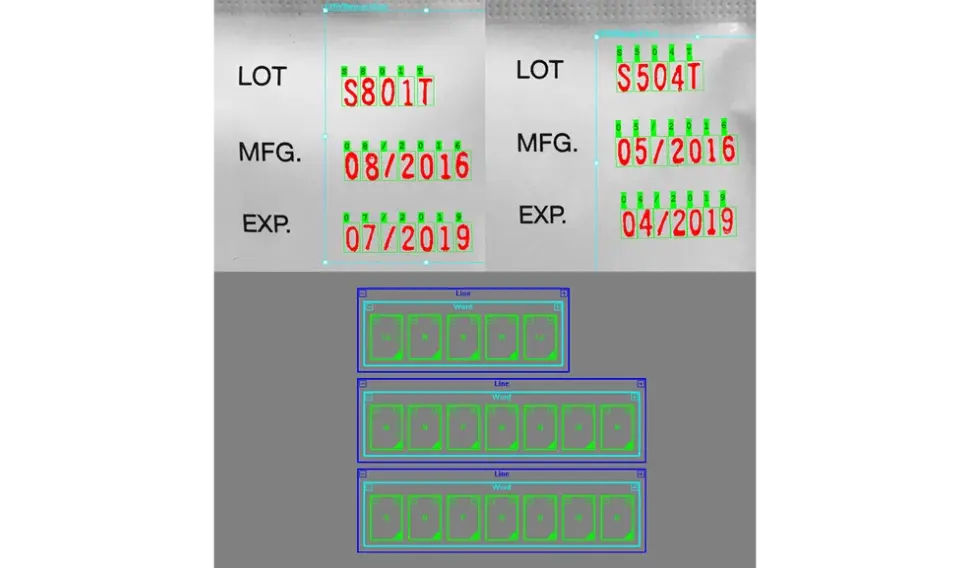
EasyOCR2 uses an advanced novel algorithm to locate the texts to read in the image. The topology of the text to detect (number of lines, words and characters) can be freely set by the user.
Character Type Specification
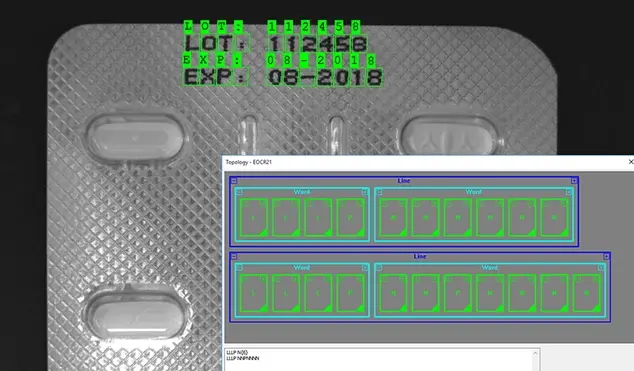
The character type (letter, digit, symbol, …) of each character can be specified to improve the recognition speed and rate.
TrueType Font (TTF) Files
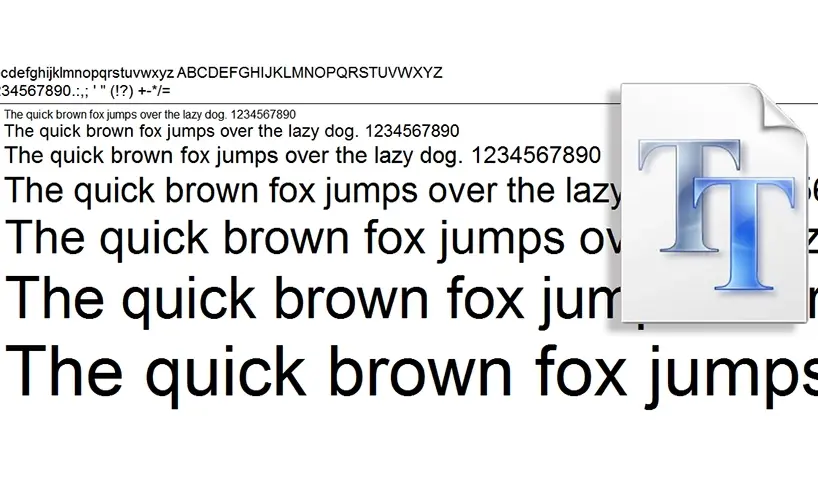
EasyOCR2 requires training the font to be recognized. This can be done either from sample images or from standard .ttf (True Type Font) files. This makes the recognition flexible, fast and reliable.
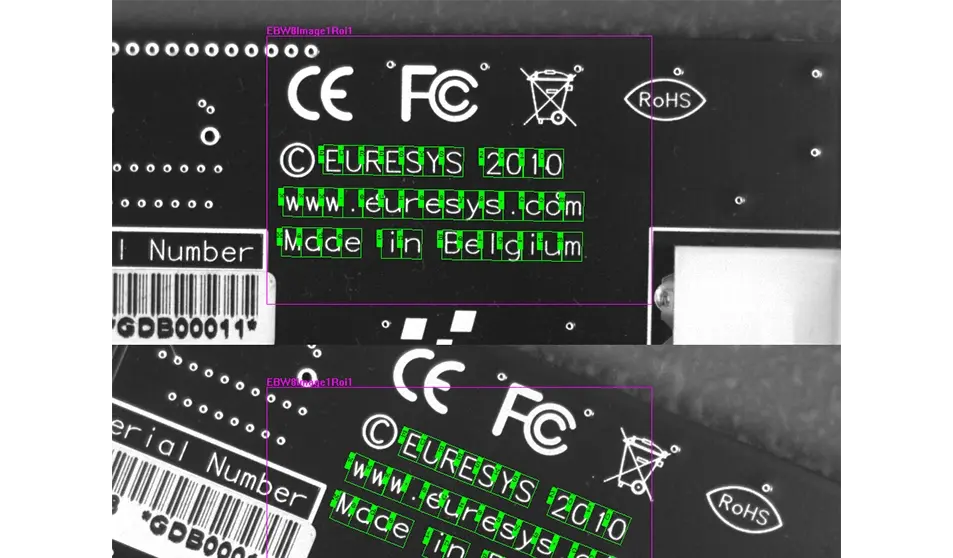
Text Rotation
Full support for text rotation (360 degrees).
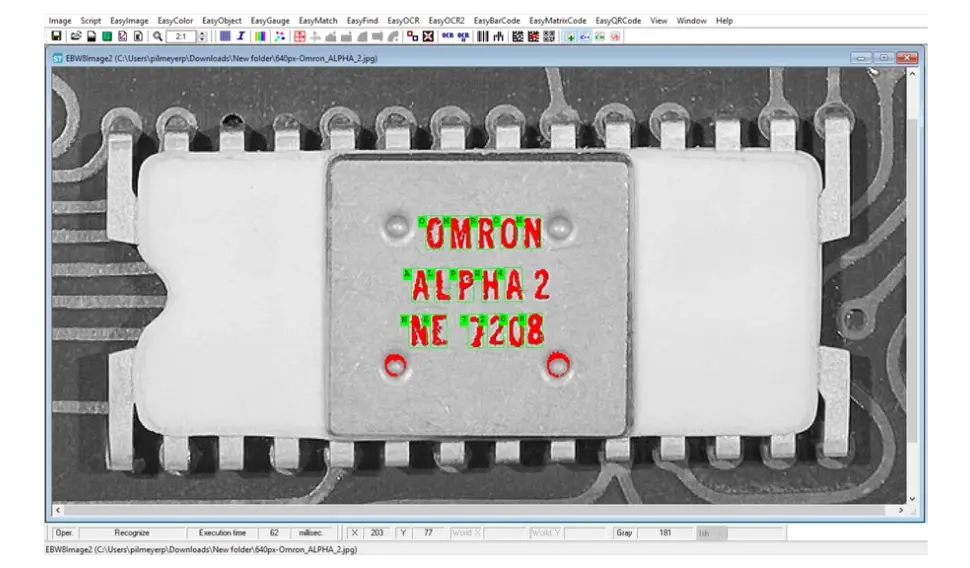
Pre-Trained Classifiers
EasyOCR2 now supports Optical Character Recognition powered by deep learning technologies. It comes with two pre-trained character classifiers that work out of the box and do not require any training! Read short texts such as part numbers, serial numbers or date codes printed using standard industrial fonts or the OCR-A font. Both classifiers support uppercase letters, numbers and the most common punctuation marks. No GPU is required. The OCR2Demo sample program as well as Open eVision Studio have been updated to support the new functionality.
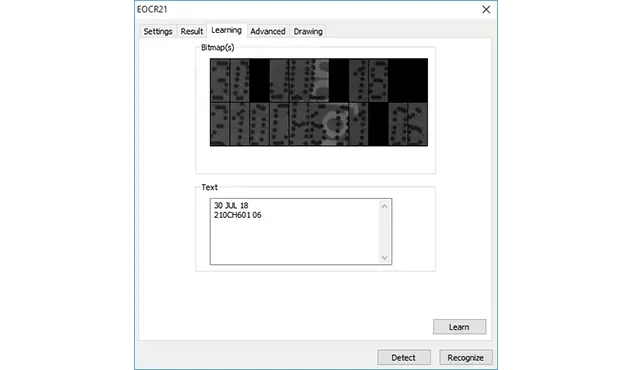
Assisted Learning
When learning from sample images, an interactive tool available in Open eVision Studio is used to identify samples of each character, allow the library to learn them and save the resulting font file.
Other Benefits
Neo Licensing System
Neo is the new Licensing System. It is reliable, state-of-the-art, and is now available to store Open eVision and eGrabber licenses. Neo allows you to choose where to activate your licenses, either on a Neo Dongle or in a Neo Software Container. You buy a license, you decide later.
Neo Dongles offer a sturdy hardware and provide the flexibility to be transferred from a computer to another. Neo Software Containers do not need any dedicated hardware, and instead are linked to the computer on which they have been activated.
Neo ships with its own, dedicated Neo License Manager which comes in two flavours: an intuitive, easy to use, Graphical User Interface and a Command Line Interface that allows for easy automation of Neo licensing procedures.
All Open eVision Libraries For Windows And Linux
- Microsoft Windows 11, 10 for x86-64 (64-bit) processor architecture
- Microsoft Windows 11, 10 IoT Enterprise on x86_64 systems
- Linux for x86-64 (64-bit) and ARMv8-A (64-bit) processor architectures with a glibc version greater or equal to 2.18
Open eVision Studio
Open eVision Studio is the evaluation, prototyping and development tool of Open eVision.
Its intuitive graphical user interface allows you to call and immediately see the result of any of eVision’s 2D image processing functions. A scripting functionality generates the corresponding code, which can then be copied and pasted into your application.
Open eVision Studio is free (when using Open eVision 2.0 and above) and does not require any license.


Software
- Host PC Operating System
-
Open eVision is a set of 64-bit libraries that require an Intel compatible processor with the SSE4 instruction set or an ARMv8-A compatible processor.
Open eVision can be used on the following operating systems:
Microsoft Windows 11, 10 for x86-64 (64-bit) processor architecture
Microsoft Windows 11, 10 IoT Enterprise for x86-64 systems
Linux for x86-64 (64-bit) and ARMv8-A (64-bit) processor architectures with a glibc version greater or equal to 2.18
Remote connections
Remote connections are allowed using remote desktop, TeamViewer or any other similar software.
Virtual machines
Virtual machines are supported. Microsoft Hyper-V, Oracle VirtualBox and libvirt hypervisors have been successfully tested.
Only the Neo Licensing System is compatible with virtualization.
Minimum requirements:
2 GB RAM to run an Open eVision application
8 GB RAM to compile an Open eVision application
Between 100 MB and 2 GB free hard disk space for libraries, depending on selected options.
- APIs
-
Supported programming languages :
The Open eVision libraries and tools support C++, Python and the programming languages compatible with the .NET (C#, VB.NET)
C++ requirements: A compiler compatible with the C++ 11 standard is required to use Open eVision
Python requirements: Python 3.11 or later is required to use the Python bindings for Open eVision
.NET requirements: .NET framework 4.8 (or later) or the .NET platform 6.0 (or later) are supported
Supported Integrated Development Environments:
Microsoft Visual Studio 2017 (C++, C#, VB .NET, C++/CLI)
Microsoft Visual Studio 2019 (C++, C#, VB .NET, C++/CLI)
Microsoft Visual Studio 2022 (C++, C#, VB .NET, C++/CLI)
QtCreator 4.15 with Qt 5.12
Ordering Information
- Product status
-
Released
- Product code - Description
-
PC4179 Open EasyOCR2 for USB dongle
PC4329 Open eVision EasyOCR2
- Related products
-
PC6512 eVision/Open eVision USB Dongle (empty)
PC6514 Neo USB Dongle (empty)