


- Localization and identification of objects/products/defects
- Counting of objects
- Axis Aligned Bounding Boxes
- Interest Point
- Supports data augmentation and masks
- Compatible with CPU and GPU processing
- Deep Learning Studio included for dataset creation, training and evaluation
- Available as part of the Deep Learning Bundle
- Also as cost effective inference-only license
Description
-
EasyLocate is the localization and identification library of Deep Learning Bundle. It is used to locate and identify objects, products, or defects in the image. It has the capability of distinguishing overlapping objects and, as such, EasyLocate is suitable for counting the number of object instances. Two methods are available:
-
“EasyLocate Axis Aligned Bounding Box” predicts the bounding box surrounding each object (or defect) it has found in the image and assigns a class label to each of them. It must be trained with images where the objects (or defects) that must be found have been annotated with a bounding box and a class label.
-
“EasyLocate Interest Point” predicts the position (as one point, typically the center, but may be otherwise defined) for each object (or defect) it has found in the image and assigns a class label to each of them. All the objects (or defects) in the image must have the same approximate size. It must be trained with images where the objects (or defects) that must be found have simply been annotated with an interest point and a class label. The annotation process is faster with EasyLocate Interest Point as a single click is enough to annotate an object.
-
What Is Deep Learning?
Neural Networks are computing systems inspired by the biological neural networks that constitute the human brain. Convolutional Neural Networks (CNN) are a class of deep, feed-forward artificial neural networks, most commonly applied to analyzing images. Deep Learning uses large CNNs to solve complex problems difficult or impossible to solve with so-called conventional computer vision algorithms. Deep Learning algorithms may be easier to use as they typically learn by example. They do not require the user to figure out how to classify or inspect parts. Instead, in an initial training phase, they learn just by being shown many images of the parts to be inspected. After successful training, they can be used to classify parts, or detect and segment defects.
Cost-Effective Inference License
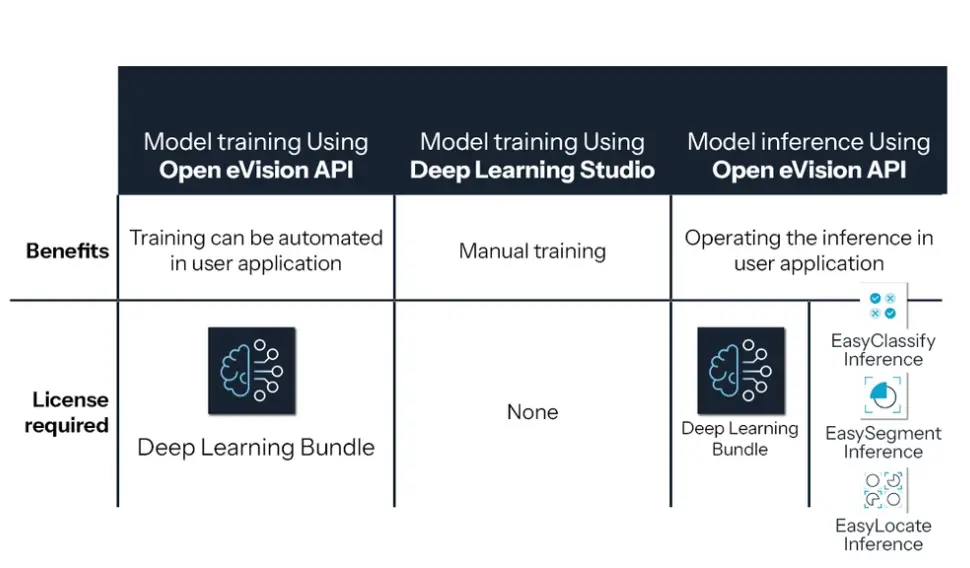
Usually , deploying Deep Learning on the production floor only requires inference processing. Inference is the process of using a previously trained model to inspect, analyze newly acquired images. The training is, in most contexts, an offline process. Training can be executed using the Open eVision API and requires a license of the Deep Learning Bundle. Alternatively, training can also be performed, free of charge, with the Deep Learning Studio application. Inference-only licenses are an alternative to the Deep Learning Bundle license, allowing the customer to deploy cost-optimized deep learning solutions.
Data Augmentation
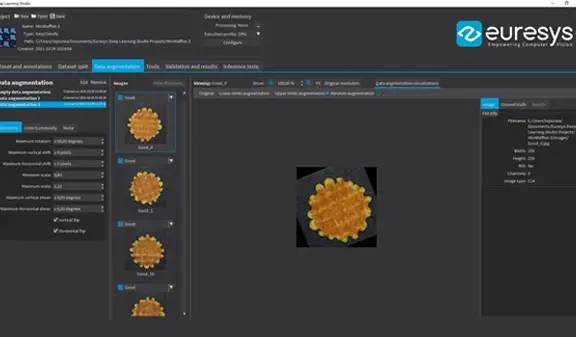
Deep Learning works by training a neural network, teaching it how to classify a set of reference images. The performance of the process highly depends on how representative and extensive the set of reference images is. Deep Learning Bundle implements “data augmentation”, which creates additional reference images by modifying (for example by shifting, rotating, scaling) existing reference images within programmable limits. This allows Deep Learning Bundle to work with as few as one hundred training images per class.
Performance
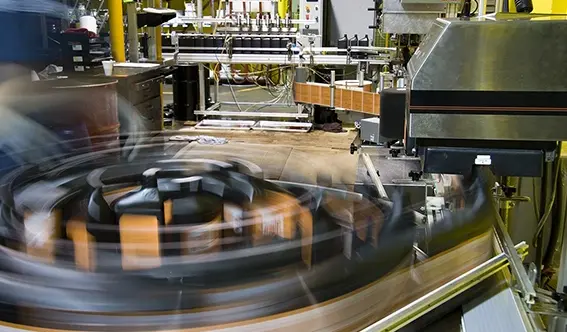
Deep Learning generally requires significant amounts of processing power, especially during the learning phase. Deep Learning Bundle supports standard CPUs and automatically detects Nvidia CUDA-compatible GPUs in the PC. Using a single GPU typically accelerates the learning and the processing phases by a factor of 100.
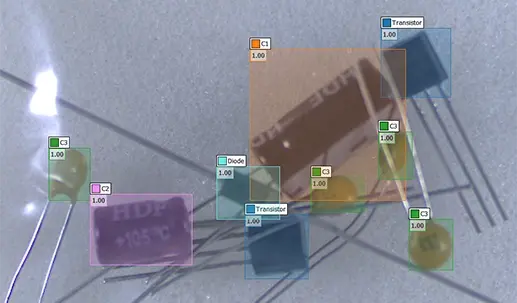
Sample Dataset: Electronic components
Our “Electronic Component” dataset shows how EasyLocate Bounding Box is able to reliably detect and count different kinds of standard electronic components stored in bulk inside plastic bags, in spite of the poor lighting conditions.
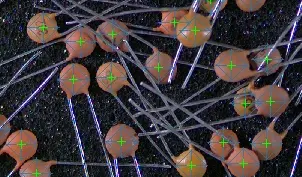
Sample Dataset: Ceramic Capacitor
Our “Ceramic Capacitor” dataset shows how EasyLocate Interest Point is able to reliably detect and count a lot of ceramic capacitors that are overlapping or touching each other.
Other Benefits
Neo Licensing System
Neo is the new Licensing System. It is reliable, state-of-the-art, and is now available to store Open eVision and eGrabber licenses. Neo allows you to choose where to activate your licenses, either on a Neo Dongle or in a Neo Software Container. You buy a license, you decide later.
Neo Dongles offer a sturdy hardware and provide the flexibility to be transferred from a computer to another. Neo Software Containers do not need any dedicated hardware, and instead are linked to the computer on which they have been activated.
Neo ships with its own, dedicated Neo License Manager which comes in two flavours: an intuitive, easy to use, Graphical User Interface and a Command Line Interface that allows for easy automation of Neo licensing procedures.
All Open eVision Libraries For Windows And Linux
- Microsoft Windows 11, 10 for x86-64 (64-bit) processor architecture
- Microsoft Windows 11, 10 IoT Enterprise on x86_64 systems
- Linux for x86-64 (64-bit) and ARMv8-A (64-bit) processor architectures with a glibc version greater or equal to 2.18
Open eVision Deep Learning Studio
Open eVision includes the free Deep Learning Studio application. This application assists the user during the creation of the dataset as well as the training and testing of the deep learning tool. For EasySegment, Deep Learning Studio integrates an annotation tool and can transform prediction into ground truth annotation. It also allows to graphically configure the tool to fit performance requirements. For example, after training, one can choose a tradeoff between a better defect detection rate or a better good detection rate.
Software
- Host PC Operating System
-
Open eVision is a set of 64-bit libraries that require an Intel compatible processor with the SSE4 instruction set or an ARMv8-A compatible processor.
Open eVision can be used on the following operating systems:
Microsoft Windows 11, 10 for x86-64 (64-bit) processor architecture
Microsoft Windows 11, 10 IoT Enterprise for x86-64 systems
Linux for x86-64 (64-bit) and ARMv8-A (64-bit) processor architectures with a glibc version greater or equal to 2.18
Remote connections
Remote connections are allowed using remote desktop, TeamViewer or any other similar software.
Virtual machines
Virtual machines are supported. Microsoft Hyper-V, Oracle VirtualBox and libvirt hypervisors have been successfully tested.
Only the Neo Licensing System is compatible with virtualization.
Minimum requirements:
2 GB RAM to run an Open eVision application
8 GB RAM to compile an Open eVision application
Between 100 MB and 2 GB free hard disk space for libraries, depending on selected options.
- APIs
-
Supported programming languages :
The Open eVision libraries and tools support C++, Python and the programming languages compatible with the .NET (C#, VB.NET)
C++ requirements: A compiler compatible with the C++ 11 standard is required to use Open eVision
Python requirements: Python 3.11 or later is required to use the Python bindings for Open eVision
.NET requirements: .NET framework 4.8 (or later) or the .NET platform 6.0 (or later) are supported
Supported Integrated Development Environments:
Microsoft Visual Studio 2017 (C++, C#, VB .NET, C++/CLI)
Microsoft Visual Studio 2019 (C++, C#, VB .NET, C++/CLI)
Microsoft Visual Studio 2022 (C++, C#, VB .NET, C++/CLI)
QtCreator 4.15 with Qt 5.12
Ordering Information
- Product status
-
Released
- Product code - Description
-
PC4189 Open EasyLocate for USB dongle
PC4339 Open eVision EasyLocate
PC4194 Open EasyLocate Inference for USB dongle
PC4344 Open eVision EasyLocate Inference
- Related products
-
PC4182 Open Deep Learning Bundle for USB dongle
PC4332 Open eVision Deep Learning Bundle